About
About
I'm a computational scientist turned AI engineering leader. For over a decade I've used computation, physics, and machine learning to make hard problems tractable — and, increasingly, to build and lead the production AI systems that put those methods to work.
One continuous project · expanding the radius of solvable problems
2014
Physical chemistry
B.S., RIT
2014 – 22
Computational physics & X-ray
PhD WSU · LBNL
2022 – 25
Medical & federal AI
VA · Harvard MRCAS
2025
Production AI engineering
Datacor
now
Technical leadership
Lead FDE, Datacor
My path looks eclectic on paper — physical chemistry, computational physics, scientific machine learning, medical and federal AI research, production AI engineering, enterprise architecture, technical leadership. But it has been one continuous project: progressively expanding the range of problems I can actually solve. Each stage added a capability rather than replacing the one before it.
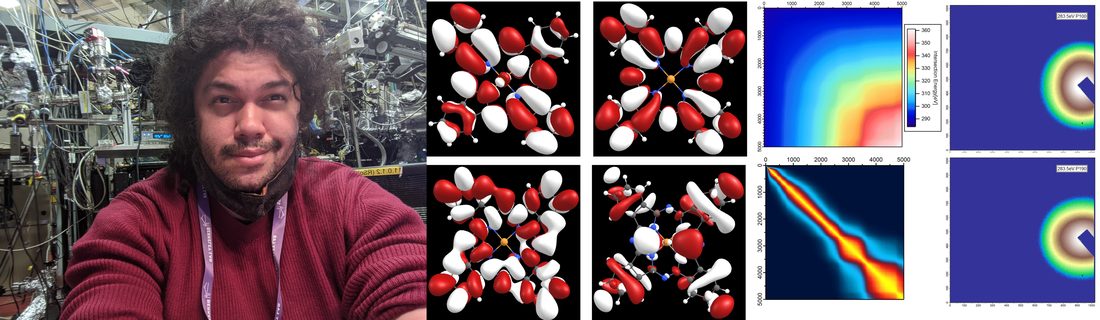
From first principles RIT · WSU · LBNL
I started in the physical sciences — a B.S. in Chemistry, with minors in Mathematics and Philosophy, from the Rochester Institute of Technology, then a PhD in Materials Science & Engineering from Washington State University, where I specialized in computational physics and chemistry.
My doctoral research combined first-principles density functional theory, dimensionality reduction, and X-ray spectroscopy to build quantitative, physically interpretable models of molecular orientation in organic nanostructures. It resolved a longstanding limitation in quantitative resonant soft X-ray analysis and led to a first-author paper accepted to Physical Review Letters. As an affiliate research scientist at Lawrence Berkeley National Laboratory's Molecular Foundry, I ran large-scale DFT at NERSC and worked the soft- and hard-X-ray beamlines the theory was tested against. That work is the clearest example of how I like to operate: take an intractable measurement problem, and make it quantitative.
Into AI, with real stakes VA · Harvard · 2022–25
I then moved into AI and data-science research where the outputs mattered to people. For nearly three years I worked with the U.S. Department of Veterans Affairs in Boston — as a Data Scientist at MAVERIC and an AI Researcher at the National Artificial Intelligence Institute — on clinical trial matching, medical imaging, clinical NLP, and trustworthy, explainable AI, earning the VA's highest federal performance rating two years running. In parallel, I worked with Dr. Marco Zenati's Harvard MRCAS laboratory on surgical-safety AI — multimodal models of cognitive load and team communication in the operating room. The throughline was the same as in the physical sciences: extract reliable structure from complex, messy, high-stakes data.
Building and leading production AI Datacor · now
Today I'm Lead Forward Deployed AI Engineer at Datacor (promoted from Lead AI Engineer), where I define and execute enterprise AI strategy and architect production AI systems across enterprise and scientific software — LLM systems, document and multimodal intelligence, retrieval and agentic workflows, and the evaluation and reliability work that keeps them dependable. Much of my work is forward-deployed: sitting with the customers and teams who use these systems, and shipping against their real problems.
The combination I care about — scientific depth, engineering ability, and production execution — is the same one I try to bring to every problem.
Education & recognition
Education
Recognition
Elsewhere
Find me on GitHub and LinkedIn, read the research, or email me at victor.murcia@wsu.edu.